Step 1 of 2
Where should we send your Complete Pricing System?
By continuing, you agree to our Terms and Privacy Policy. Unsubscribe any time.
Step 2 is the order form.
Stop losing money on antique booth pieces that sit for months
Managing an antique booth can be a fun and rewarding experience. But too many people don’t understand what it takes to consistently turn a profit and end up giving up. The problem is that conventional pricing advice actually ignores the most important factor in whether you make or lose money on each piece you sell. Keep reading for the solution.
You thought you were doing everything right. You have a sharp eye for a bargain, and you found great pieces for a fraction of what they’re worth. And you carefully priced your inventory using the best advice you could find online and in books.
But, month after month, the same pieces are still sitting in your booth. And when your payout comes in, there’s hardly anything left after rent. Some months your payout doesn’t even cover the rent. It’s hard to see what’s going wrong, because every piece you’ve sold looked like a profit.
A typical scenario
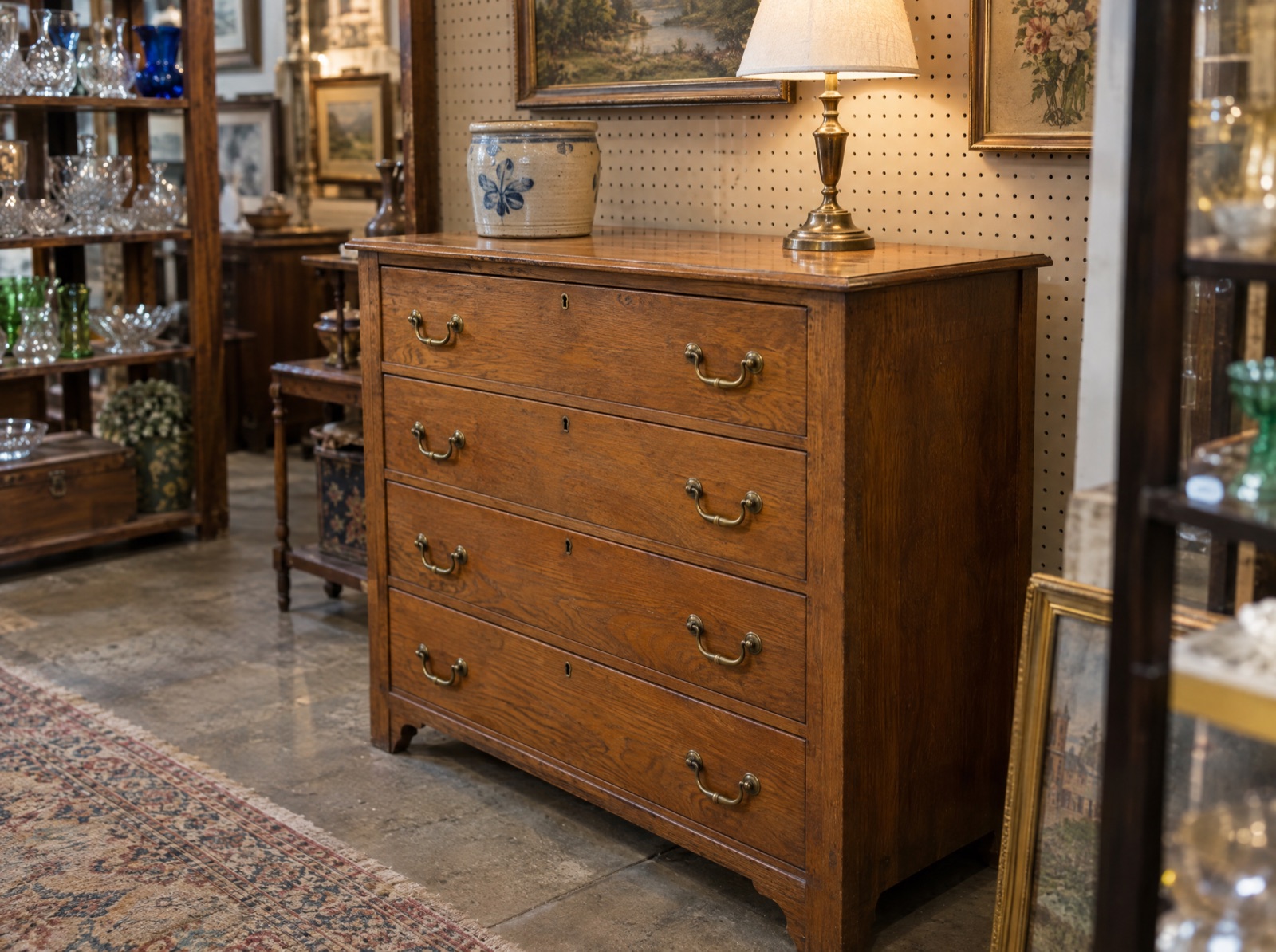
You pay $40 for a beautiful oak dresser at an estate sale. You’re excited at the great deal you got on it. You follow conventional wisdom and price the item at 3x what you paid, or $120. Four months later, the dresser sells and you’re excited because you just made a sweet $80 profit.
Or did you?
In reality, that $40 dresser you sold for $120 could have lost you money.
Not understanding why is a big part of why so many vendors barely cover their rent, and eventually give up.
Let’s break it down
Say you rent an 8x10 booth for $240 a month, and your mall keeps 13% of every sale for its commission and card fees. And let’s say that dresser takes up about 10% of your booth space.
You followed the conventional wisdom that says to tag the dresser at three times what you paid: $120. And when it sold, that felt like $80 in your pocket. Or maybe it felt like about $64 if you factored in the mall’s fees.
But even if you factored the mall fees into your math, you still left out the most important factor — the one that almost everyone ignores. And that factor is the “rent” that the item pays for the space it takes up, day after day, until it sells.
The big idea
A piece doesn’t just cost what you paid for it. It also costs the rent on the space it takes up, for every day it sits in your booth.
Let’s take another look at what happened with that dresser you just sold. This time, we’ll count everything it cost you, including the dresser’s “rent”:
| 3x Cost Method | |
|---|---|
| What you paid | $40 |
| What you sold it for | $120 |
| When it sold | Month 4 |
| Payout after mall fees | $104.40 |
| 10% of booth rent for 4 months | −$96 |
| What you think you made | $80 |
| What you actually LOST | $31.60 |
Our own Rent Share Method was created to put that missing cost back into every decision you make about a piece: what to pay for it, what to tag it, and what to do when it doesn’t sell. It works out what each piece costs you to keep, day by day, from your own rent and your own booth. No spreadsheet to keep up, no sold comps, no tape measure. So you can see a loss like that dresser’s coming before you ever hand over the $40.
How it works
Your mall rents you space by the day. Your prices don’t know that.

Your mall rents you space by the square foot, by the month. That’s the whole deal, and it’s the one cost every piece in your booth is running up whether or not anybody touches it. Typical booth rent runs $100 to $600 a month, and the mall commonly takes 10% to 15% commission on top.1
Now look at what you were told to do about a piece that isn’t selling.
- “Mark it down at 60 or 90 days”
- “Price at 3x what you paid, or 4x, or 7x”
- “Check the sold comps”
Every one of those tries to answer “What is this worth?”
Not one of them answers “What is this costing me to keep?”
That second question is the one the Rent Share method answers. And the concept is very simple.
Here’s the four step process in a nutshell:
Work out your rent share
Turn your rent into a cost per square foot per day. In the example booth we use throughout — $240 a month, 8 by 10 feet, a 13% mall cut — that’s 10¢ per square foot per day. Ready-made tables cover rent levels from $1 to $5, so for most booths this is looking up one number.
In the guide: Pages 18–23 help you find your rent level and your share of each sale, then give you a ready-made table of what any piece costs to keep.
Know what each piece costs to keep
In that example booth, a teacup set costs a nickel a day to keep. A dresser costs 80¢. Same shelf, same date on the tag, sixteen times the bill.
In the guide: Pages 8–14 show why pieces sit, and page 21 shows how to sort every piece by size and speed.
Put a sell-by date on the tag
Set by the piece’s size and by how fast that kind of piece sells in your mall — not a flat 90 days for everything. Big and slow gets a short leash. Small and quick gets a long one.
In the guide: Pages 31–36 show how to find each piece’s price floor and sell-by date, with five worked examples.
Sweep once a month
Every piece past its date gets one comparison: is the markdown it needs smaller than what its space will cost over the next 30 days? Yes, cut it. No, it moves, bundles or comes out. You finish with a decision on every piece, not a list of valuations.
In the guide: Pages 24–30 walk you through your first sweep, and pages 40–41 show how each sweep teaches you what your mall buys.
Here’s what that means for the $40 dresser from the top of this page. Run the numbers before you buy, and Rent Share tells you that a dresser that takes four months to sell in your booth has to bring at least $203 to make a $40 profit.
| 3x Cost Method | Rent Share Method | |
|---|---|---|
| What you paid | $40 | $40 |
| What you sold it for | $120 | $203 |
| When it sold | Month 4 | Month 4 |
| Payout after mall fees | $104.40 | $176.61 |
| 10% of booth rent for 4 months | −$96 | −$96 |
| Your actual profit or loss | −$31.60 | +$40.61 |
So pass on the dresser that would only sell for $120, and hold out for a $40 dresser your mall’s shoppers will pay $203 for. Same cost, same corner of your booth, same four months.

Imagine running your booth without any of this:
- NO spreadsheet you have to update every week
- NO looking up comps for a piece nobody’s searching for
- NO tape measure
- NO decision that depends on a shopper showing up
What’s inside
One guide, six tools
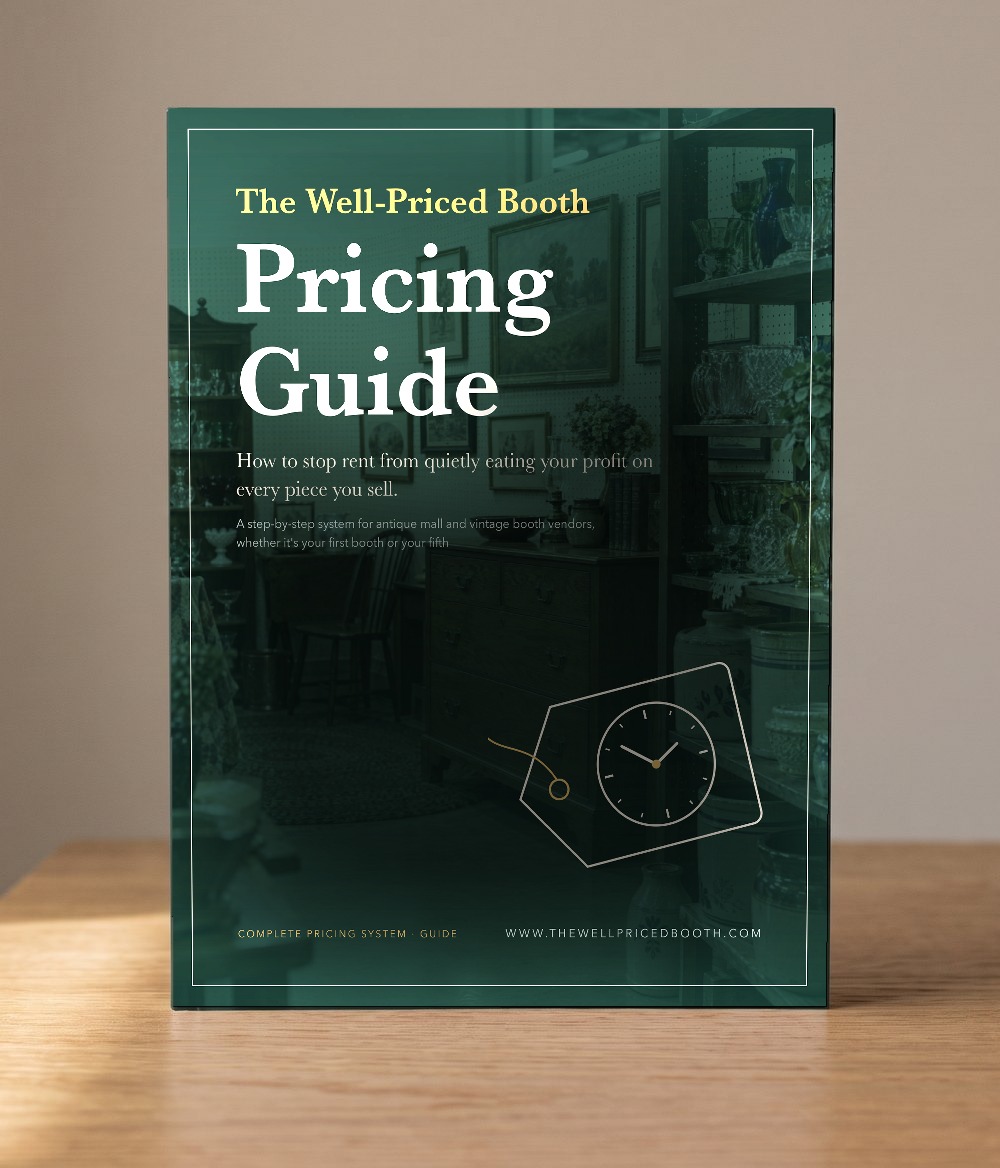
The Pricing Guide
47 pages, written for first-time vendors and people who’ve had a booth for years. It explains why pieces sit, walks you through the five steps, and answers the questions that come up once you start — with a setup worksheet, a 30-day plan, a booth map, a tag checklist, the sitting piece decision chart and the exact math printed right inside it.
A look inside the guide
Three real pages. Click any one to read it full size.


Plus 6 printable tools, included
Each one its own PDF, so you print only the sheet you need.
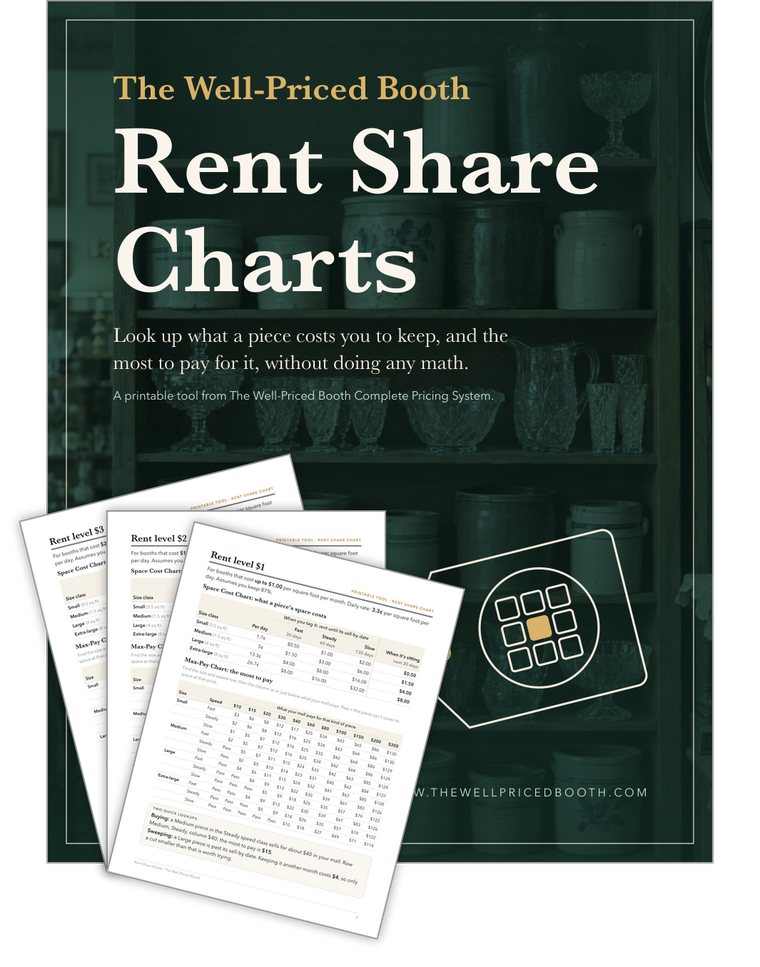
Rent Share Charts and Max-Pay Charts
Look up what a piece costs you to keep, and the most to pay for it, without doing any math
Included
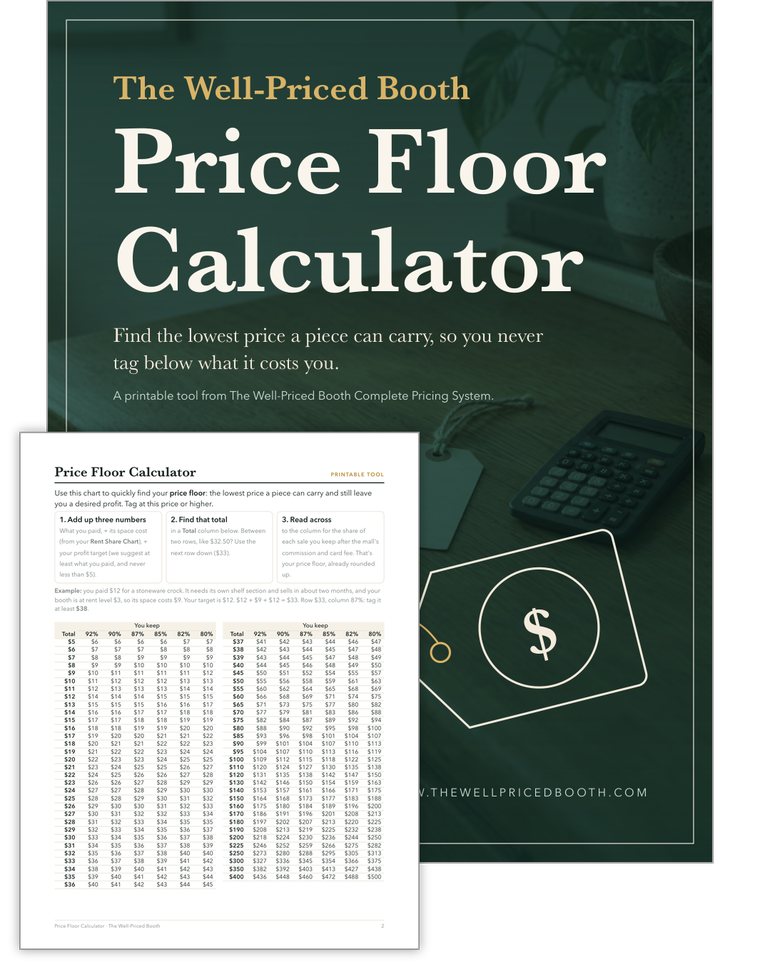
Price Floor Calculator
Find the lowest price a piece can carry, so you never tag below what it costs you
Included
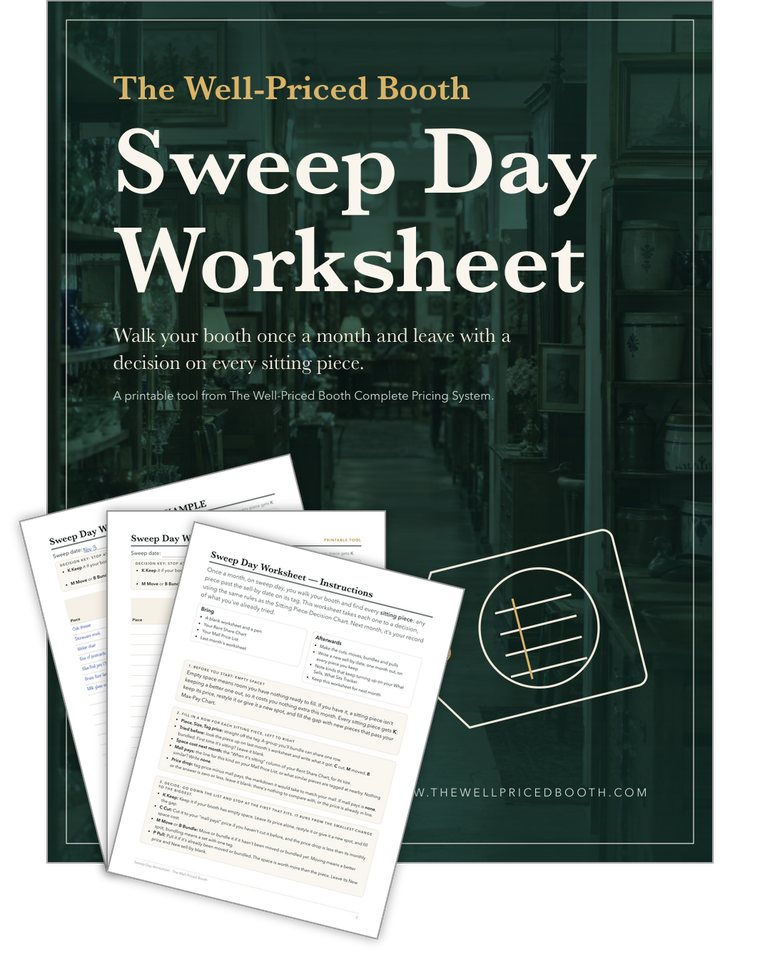
Sweep Day Worksheet
Walk your booth once a month and leave with a decision on every sitting piece
Included

What Sells, What Sits Tracker
Learn how fast each kind of piece sells in your mall, and set your speed classes from your own booth
Included

Mall Price Tracker
Find out what shoppers in your mall actually pay for each kind of piece, and keep it on one list
Included
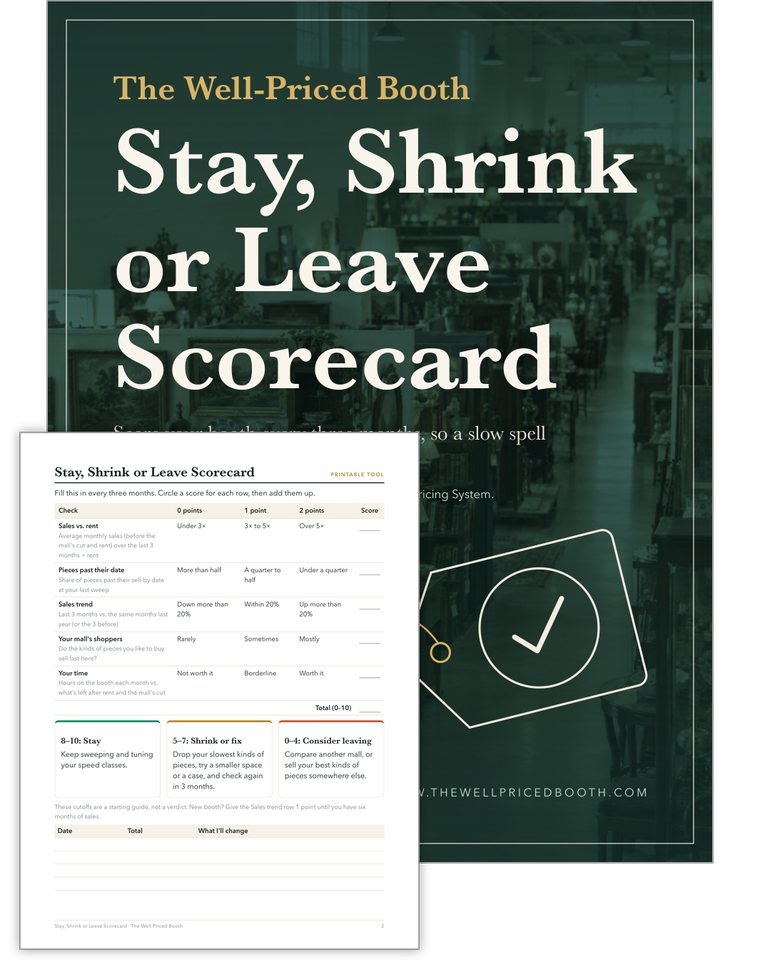
Stay, Shrink or Leave Scorecard
Score your booth every three months, so a slow spell doesn’t become a gut decision
Included
The promise
Within 30 days, you’ll know what every piece in your booth is costing you to keep, and exactly what to do about each one past its sell-by date: cut the price, move it, bundle it with something else, or pull it.
Before you decide
What this system will and won’t do for you
What the Complete Pricing System does for you: It gives you mathematically rigorous guidance, so every price you set covers your booth fees and the profit margin you want. The included charts and tools do as much of the math as possible for you, so you can spend more time on what you actually enjoy about managing your booth.
What it won’t do: It won’t make pieces sell faster, make items sell for more, or guarantee your sales will clear your rent — those depend on your items, your mall, and its shoppers. Instead, it shows you which pieces aren’t pulling their weight, and gives you one call on each: cut, move or pull, explained with simple arithmetic.
You must commit one afternoon and an hour every month: One afternoon to set things up: walking the booth, working out rent per square foot per day, and putting dates on tags that don’t have them. After that you need to perform a “sweep” once a month. It takes about an hour, and the sweep is the method — skip it and you won’t benefit from the system.
It runs on your numbers: Every pricing recommendation comes from your rent, your booth size, your mall’s commission and card fees, and how fast each kind of piece sells at your mall and in your booth. That speed information comes from your sales data — your mall’s reports or your own notes on what sold. But until you have them, the guide gives you starting estimates and tells you when to change them.
Who should not use this system: If your mall operates purely on commission, with no fixed monthly rent, our method will not give you useful advice, and you shouldn’t purchase it.
Included
Two things that come with it
Free updates, forever, on the page you already have. Your files page doesn’t expire. Bookmark it, come back any time, and every link on it is live again — always serving the current version of each document. This isn’t a promise about the future; it’s how the delivery already works.
The Well-Priced Booth Quick Check. The free starter, with the pages on comparing booths and the questions to ask a mall before you sign. Useful if you’re ever thinking about a second booth.
Everything you get
The Well-Priced Booth
Complete Pricing System
$27.00
One payment. Instant download.
What’s inside
- The 47-page Pricing Guide — the whole method, in five steps
- Rent Share Charts and Max-Pay Charts
- Price Floor Calculator
- Sweep Day Worksheet
- What Sells, What Sits Tracker
- Mall Price Tracker
- Stay, Shrink or Leave Scorecard
- Rent Share Setup Worksheet
- 30-day Getting Started plan
- Booth Space Map
- Tag Dates and Monthly Sweep Checklist
- Sitting Piece Decision Chart
- The Well-Priced Booth Quick Check
7-day money-back guarantee
Why only $27.00? The Well-Priced Booth Complete Pricing System recently launched and we’re looking to collect testimonials from real booth vendors, since recommendations from real users are the most powerful sales tool we could have.
The information and tools in the system will be priced at $179 once those reviews are in, and we know that’s a significant investment to make without real success stories from real users behind it. So until then it’s $27.00, with a no-questions-asked 7-day money-back guarantee.
Once we’ve collected at least 50 positive reviews of the system, we intend to raise the price to $179. So get in before it does — and if it isn’t for you, the 7 days are there for exactly that.
Want the tags and signs ready-made? The Tag & Sign Pack ($17.00) and the Sales Report Workbook ($27.00) are offered at checkout, and nowhere else.


Guaranteed safe & secure checkout powered by
Frequently Asked Questions
What does this cost me beyond the $27.00?
Only the cost of printing pages. The printable tools are designed for plain paper and black and white. Nothing else is required to implement the system.
How long until it makes me money?
We can’t tell you that, and be suspicious of anyone who says they can. What we can tell you is what the method produces and when: a decision on every piece past its date, within 30 days of starting.
Isn’t the booth space saturated with pricing advice?
There’s plenty of advice available and most of it is free — markup multiples, sold comps, mark down at 90 days. None of it accounts for the space a piece takes or the days it sits, and ours is the only approach we’ve found that does.
My mall works differently. Will it still apply?
If your mall charges by the square foot, by the month, this guide will work for you. If it charges a flat booth fee, the guide shows you how to convert that to a per-square-foot rate. If it’s commission-only with no rent, the Rent Share method doesn’t apply and you shouldn’t buy this guide.
Booths have shelves and other ways to fit multiple items into a single square foot. Does your method account for that?
Yes. The guide never counts a piece as taking up a full square foot. Every piece goes into one of four size classes based on how much of your booth it really uses, and those already allow for shelves: a teacup set on a shelf counts as half a square foot, a lamp or crock with its own shelf section as a square foot and a half, and floor pieces like chairs and dressers by the floor they cover. Pieces hanging on a wall count by the display space they take. You measure your booth once, and never measure a piece.
What if I’m brand new and don’t have a booth yet?
Then start with the free Quick Check instead. It has the pages on comparing booths and what to ask a mall. Come back when you’ve signed something.
Do I need a spreadsheet or any software?
No. Everything can be done by hand on paper. There’s a separate workbook with a spreadsheet available if you want it later, but the method was meant to be easily implemented without need for a computer.
What if it doesn’t work for me?
Email support@thewellpricedbooth.com within 7 days and we’ll refund it, no questions asked. That’s the whole process — no form, no reason required.
7-day refund, no questions asked. Instant download.
Notes
- ResaleOS, “Antique booth break-even rent math”, 3 August 2026. ↩
This is an education product about pricing and merchandising. It is not financial, tax, legal or business advice, and it makes no claim about what you will earn. Examples use a made-up booth with its assumptions stated, to show how the arithmetic works. Your results depend on your mall, your pieces and your shoppers, and no pricing method can promise a sale.
ResaleOS, Lost & Found Decor and Vintage Booth Pro are cited by name where their published advice is discussed. Citation is not endorsement, and none of them is connected to this product.
The Well-Priced Booth is a trading name of Jumpstart Solutions, LLC. This site is not affiliated with, endorsed by, or sponsored by Meta Platforms, Inc. or Facebook.